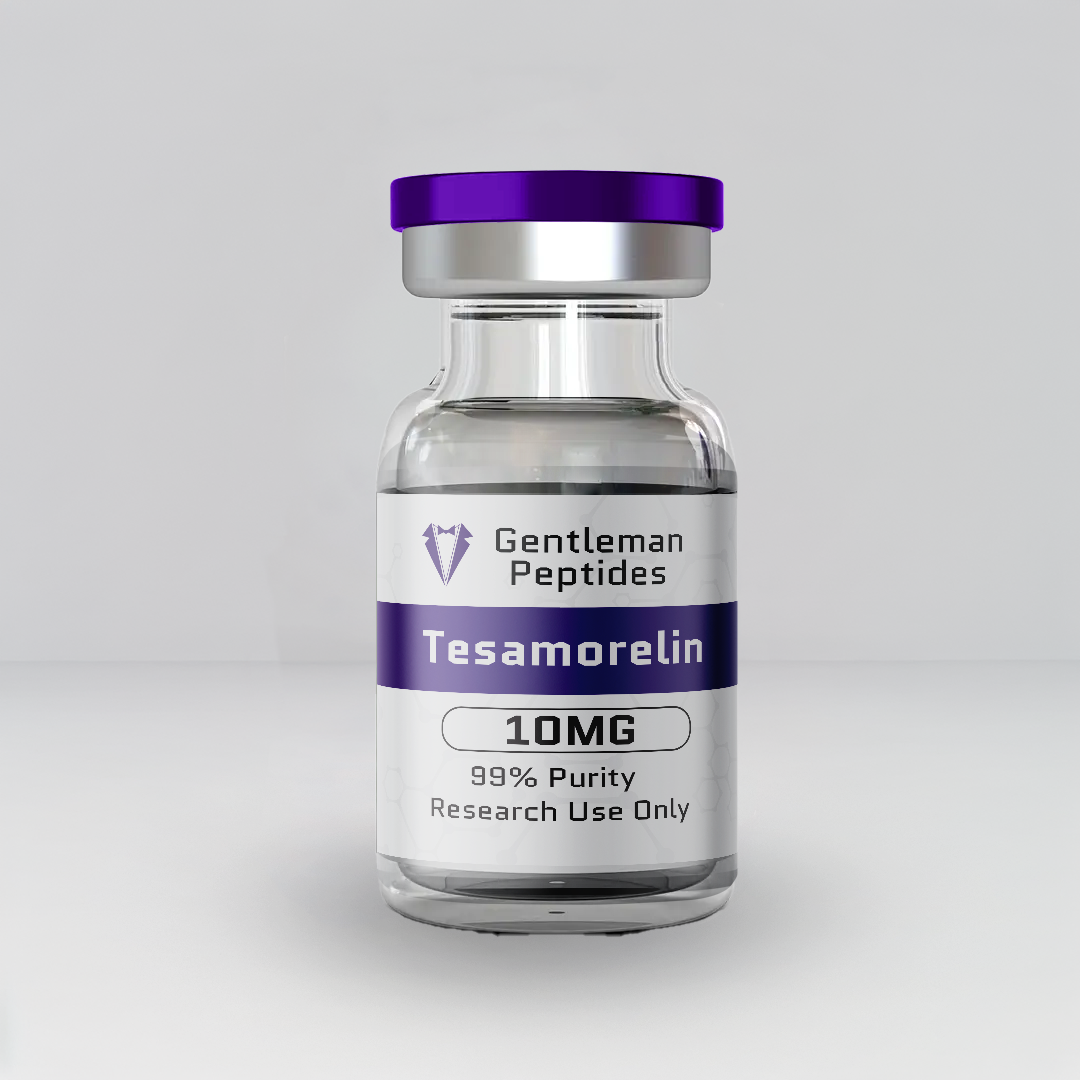
Buy Tesamorelin
Tesamorelin — GHRH Analog Peptide, Research Use Only
Tesamorelin is a synthetic growth hormone-releasing hormone (GHRH) analog developed for research use. It is not approved for human or veterinary administration in this context. Researchers use it to study visceral adiposity, metabolic regulation, and growth hormone axis modulation.
What Is Tesamorelin?
Tesamorelin (structure based on 44 amino acids of human GHRH with a trans-3-hexenoic acid modification) is designed to stimulate endogenous growth hormone (GH) release via the pituitary. It is FDA-approved clinically for reduction of excessive abdominal fat in HIV-associated lipodystrophy under the brand name Egrifta.
Key Attributes of Tesamorelin
- Type: Synthetic GHRH analogue
- Structure: 44 aa with N-terminal modification for stability (GHRH + trans-3-hexenoic acid)
- Route (clinical): Subcutaneous injection (clinically) with ≤4% bioavailability
- Half-life: 26–38 minutes
- Approved use (clinical): Reduces visceral adipose tissue (VAT) in HIV lipodystrophy
- Research status: Experimental/synthesis use only in this context
Research Use Cases & Mechanisms
- Visceral Fat Reduction Models: Clinical trials in HIV patients show ~15–17% VAT reduction vs placebo.
- Liver Fat / NAFLD Models: Tesamorelin has been shown to reduce liver fat content and slow fibrosis progression in HIV with NAFLD.
- Muscle Quality / Density: Tesamorelin may increase muscle density and quality among responders.
- Metabolic & Lipid Effects: Reductions in LDL and non-HDL cholesterol observed in some studies within 12 weeks.
- CVD Risk Impact: VAT reduction by tesamorelin may modestly reduce predicted cardiovascular disease risk.
Peptide & Pharmacokinetics
- Amino Acid Composition: 44 aa GHRH analog with N-terminal modification
- Molecular Behavior: Modified for improved stability and resistance to enzymatic cleavage
- Metabolism & Excretion: Degraded via proteolysis and renal elimination
- Pharmacodynamics: Stimulates pituitary GH release → increases IGF-1
- Clinical Route / Dosing: In human trials, 2 mg daily subcutaneous doses used
Verification & Safety Notes
- All vials produced with research-grade purity and accompanied by batch COA (link via COA Hub)
- Use COA Guide for interpreting test results
- Safety & handling procedures recommended in Peptide Safety
- Clinically, tesamorelin is generally well tolerated: injection site effects, mild glucose perturbation risk
Tesamorelin vs GH Therapy vs GHRP / Peptide Stacks
Tesamorelin vs Exogenous GH: Tesamorelin stimulates endogenous GH secretion with feedback control, potentially reducing risk versus direct GH administration.
Tesamorelin vs GHRP / Peptide Stacks: Different mechanism — GHRPs act on GH-secretagogue receptors, whereas tesamorelin mimics GHRH. Stacks combining both may be explored in research.
Clinical vs Research Use: In your context, treat tesamorelin as a research analog only, not a therapeutic. Link to Compare Hub to allow side-by-side with other GH axis peptides.
Comparison of GH-Axis Agents
| Agent | Mechanism | GH Effect | Use Case | Notes |
|---|---|---|---|---|
| Tesamorelin | GHRH analog | Stimulates endogenous GH | VAT/liver fat models | Feedback control, stable analog |
| Exogenous GH | Direct hormone | Bypasses regulation | Growth / anabolic studies | Higher risk of side effects |
| GHRP (e.g. GHRP-2/6) | Secretagogue receptor | Stimulates GH | Synergistic peptide stacks | Different receptor axis |
Best Practices for Tesamorelin Use in Experiments
- Use sterile reconstitution techniques (buffer, sterile water)
- Document dose, timing, route, and animal/specimen model details
- Monitor IGF-1 levels during experiments to verify biological activity
- Be cautious with glucose metrics in metabolic models
- Use controls and validate response thresholds (e.g. VAT decrease ≥8%)
FAQ — Tesamorelin
Q1. What is Tesamorelin used for clinically?
A: Clinically, tesamorelin is approved to reduce excess abdominal (visceral) fat in HIV-infected patients with lipodystrophy.
Q2. Does tesamorelin reduce visceral but not subcutaneous fat?
A: Yes — in human trials, tesamorelin selectively reduced visceral adipose tissue (VAT) while preserving subcutaneous fat.
Q3. Does tesamorelin affect liver fat?
A: Yes — trials in HIV with NAFLD show que reductions in liver fat and slower fibrosis progression.
Q4. Is tesamorelin safe metabolically?
A: Short-term trials show minimal glucose impact and improvements in lipids; IGF-1 levels increase within normal range.
Q5. Do you provide COA for tesamorelin vials?
A: Yes. Each batch is tested, and COAs are accessible via the COA Hub.
Q6. Is tesamorelin for human use in your context?
A: No — in this setting, it is strictly research use only.
Last updated: October 17, 2025
Key Studies & Reviews
- Randomized trials showing VAT reduction and improved lipid profiles (Falutz et al.): PubMed
- Effect on liver fat in HIV/NAFLD populations: PMC
- Secondary outcomes on muscle quality: PMC
- Safety / metabolic effect study: PLoS One
- Mechanistic and general background: DrugBank
- Risk / liver safety profile: LiverTox
| Weight | .25 lbs |
|---|---|
| Dimensions | 1.25 × .75 × .75 in |
All products on this site are for research and development use only. Products are not for human consumption of any kind. The statements made on this website have not been evaluated by the US Food and Drug Administration. The statements and the products of this company are not intended to diagnose, treat, cure, or prevent any disease. Gentleman Peptide is a chemical supplier. Gentleman Peptide is not a compounding pharmacy or chemical compounding facility as defined under 503A of the Federal Food, Drug, and Cosmetic Act. Gentleman Peptide is not an outsourcing facility as defined under 503B of the Federal Food, Drug, and Cosmetic Act. All products are sold for research, laboratory, or analytical purposes only, and are not for human consumption. Gentleman Peptide’s Products are intended strictly for research purposes only. These products are not approved by the U.S. Food and Drug Administration (FDA) for human consumption or medical use. Under no circumstances should these peptides be used for any purpose other than research. By purchasing or using our peptides, you acknowledge and agree that you will use them solely in accordance with applicable laws and regulations and that you accept full responsibility for their use. Statements made on this website have not been evaluated by the USA Food and Drug Administration.
Related products