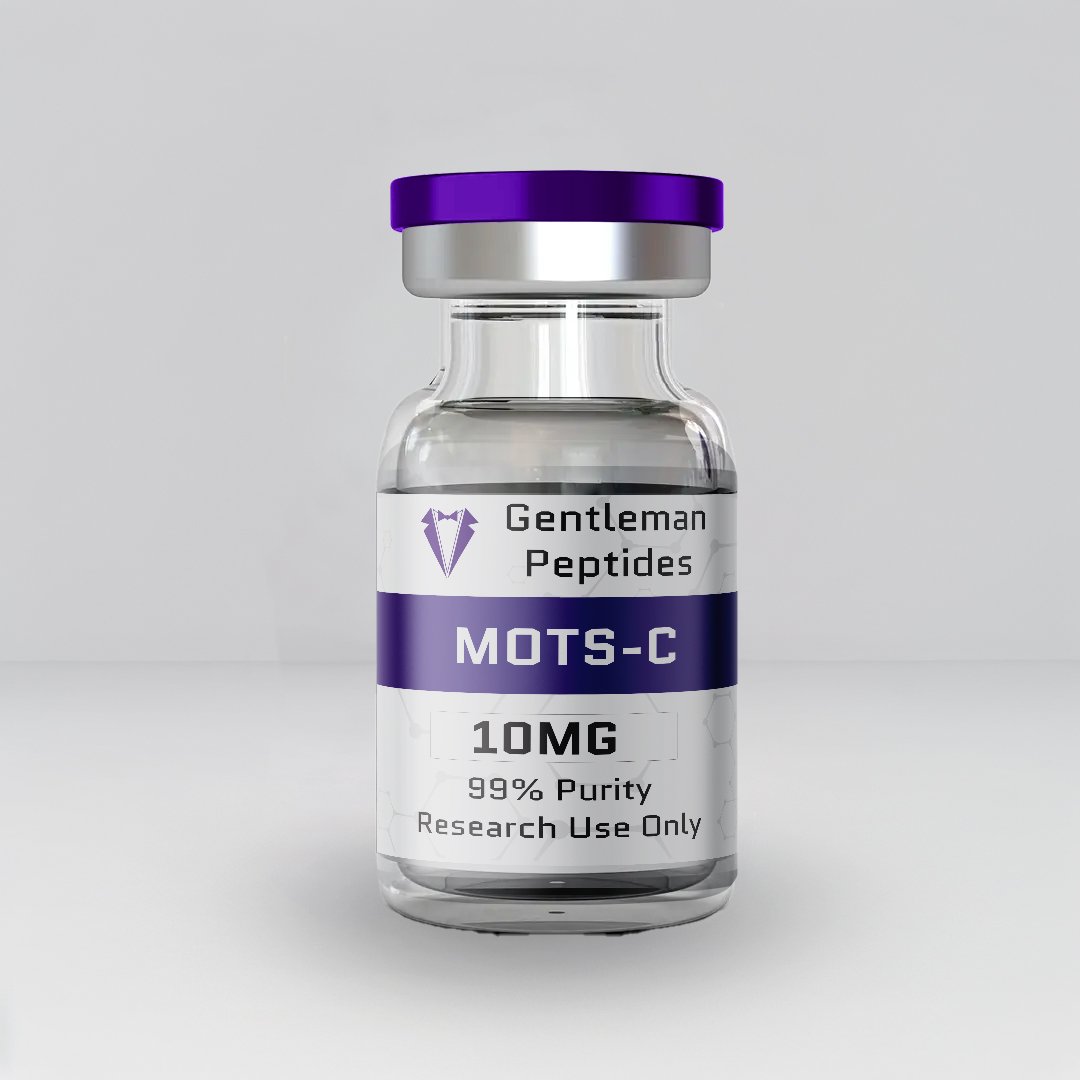
Buy MOTS-C
MOTS-C — Mitochondrial-Derived Peptide for Research Use Only
MOTS-C is a synthetic research-grade peptide derived from the mitochondrial‐encoded open reading frame of the 12S rRNA (mitochondrial ORF of the 12S rRNA type-C).
It is offered for laboratory research use only, not intended for human or veterinary use.
Researchers use it to study mitochondrial signalling, metabolism, insulin resistance, aging, and cellular energy regulation.
Overview — What Is MOTS-C?
MOTS-C (mitochondrial open reading frame of the 12S rRNA-c) is a small 16-amino-acid peptide encoded in mitochondrial DNA.
Research shows it helps regulate metabolic homeostasis in skeletal muscle, promotes insulin sensitivity, and may act as a “mitokine” — a peptide that conveys mitochondrial signals to the nucleus under stress conditions.
References:
-
PubMed
-
PMC Review
Key Attributes of MOTS-C
-
Peptide: MOTS-C (mitochondrial ORF of 12S rRNA type-C)
-
Sequence (approx.): 16 amino acids (Met-Arg-Trp-Gln-Glu-Met-Gly-Tyr-Ile-Phe-Tyr-Pro-Arg-Lys-Leu-Arg) (Wikipedia)
-
Format: Research-grade peptide vial (check product for size)
-
Purity & Testing: Research-grade purity; batch Certificate of Analysis (COA) available
-
Research Status: Experimental only; not approved for therapeutic use
-
Primary Research Focus: Metabolic regulation, insulin sensitivity, mitochondrial signalling, aging pathways
Applications & Research Uses
-
Insulin Resistance & Obesity Models:
In animal studies, MOTS-C prevented high-fat diet–induced insulin resistance and obesity via AMPK activation (PubMed). -
Mitochondrial & Metabolic Stress Response:
MOTS-C translocates to the nucleus under stress, regulates gene expression, and enhances cellular resilience (PMC). -
Skeletal Muscle & Aging:
Plasma levels decline with age; exogenous MOTS-C improved muscle performance in older mice (PeptideSciences). -
Bone & Tissue Metabolism:
Research suggests roles in bone formation and tissue-repair pathways (Frontiers).
Peptide & Vial Details
| Attribute | Detail |
|---|---|
| Sequence | ~16 amino acids encoded by mitochondrial DNA (12S rRNA ORF) (PMC) |
| Molecular Weight | Low-kDa range (small peptide) |
| Appearance & Format | Powder or sterile solution (per product spec) |
| Purity | ≥98% (batch-linked COA available) |
| Handling / Storage | Store per label; protect from light and moisture |
| Research Use | Laboratory use only — follow biosafety protocols |
Verification & Assurance
-
All MOTS-C vials include a Certificate of Analysis (COA) verifying purity and composition.
-
COAs are accessible in the COA Hub.
-
Guidance on interpretation is in the COA Guide.
-
Safe handling procedures are outlined in Peptide Safety.
 Note: MOTS-C is not approved for human or veterinary use.
MOTS-C vs Other Peptides & Signalling Molecules
-
MOTS-C vs Classical Metabolic Peptides:
MOTS-C functions via mitochondrial signalling and nuclear gene regulation, unlike receptor-mediated classical peptides. -
MOTS-C vs GH/IGF Peptides:
MOTS-C offers regulatory modulation of metabolism, not direct hormone replacement. -
Research Context:
Compare with other mitochondrial peptides, AMPK activators, or insulin-sensitizing agents via the Compare Hub.
Peptide Comparison Simplified
| Peptide | Primary Research Focus | Molecular Size | Delivery Mode | Unique Feature |
|---|---|---|---|---|
| MOTS-C | Metabolic homeostasis, mitochondrial signalling | ~16 aa | Injectable / research | Nuclear-mitochondrial signalling, exercise-mimetic |
| BPC-157 | Tissue repair, vascular healing | ~1419 Da | Oral / injectable | Stable 15-AA peptide for connective tissue |
| TB-500 | Cell migration, muscle / heart repair | ~4963 Da | Injectable | Large peptide related to thymosin β-4 |
Best Practices for MOTS-C Use in Experiments
-
Use sterile technique for reconstitution; document solvent, concentration, and route.
-
Record baseline and follow-up measures such as glucose tolerance and mitochondrial gene expression.
-
Observe dose–response relationships; most studies use µg–mg scale doses in animal models.
-
Store peptide per label; minimize freeze–thaw cycles.
-
Consider combination protocols (e.g., mitochondrial activators + MOTS-C) for metabolic research.
FAQ — MOTS-C
Q1. What is MOTS-C used for in research?
A: It’s studied for mitochondrial signalling, insulin resistance, metabolic stress adaptation, aging, and energy regulation.
Q2. Is MOTS-C approved for human consumption or treatment?
A: No — MOTS-C is for research use only, not for human or veterinary use.
Q3. What research supports MOTS-C’s metabolic effects?
A: Studies show MOTS-C prevents obesity and insulin resistance through AMPK pathway activation (PubMed).
Q4. How should MOTS-C be stored and handled?
A: Keep sealed, store refrigerated or as labeled, protect from light/moisture, and avoid repeated freeze–thaw.
Q5. Are there comparisons of MOTS-C vs other peptides?
A: Yes — see the Compare Hub for matrix comparisons (e.g., BPC-157, TB-500).
Last updated: October 17, 2025
Key Studies & Reviews
-
Metabolic regulation: PubMed
-
Aging and metabolism review: MDPI
-
Mitochondrial-nuclear signalling study: Nature
-
Bone metabolism: Frontiers
| Weight | .1 lbs |
|---|---|
| Dimensions | .75 × .75 × 1.25 in |
All products on this site are for research and development use only. Products are not for human consumption of any kind. The statements made on this website have not been evaluated by the US Food and Drug Administration. The statements and the products of this company are not intended to diagnose, treat, cure, or prevent any disease. Gentleman Peptide is a chemical supplier. Gentleman Peptide is not a compounding pharmacy or chemical compounding facility as defined under 503A of the Federal Food, Drug, and Cosmetic Act. Gentleman Peptide is not an outsourcing facility as defined under 503B of the Federal Food, Drug, and Cosmetic Act. All products are sold for research, laboratory, or analytical purposes only, and are not for human consumption. Gentleman Peptide’s Products are intended strictly for research purposes only. These products are not approved by the U.S. Food and Drug Administration (FDA) for human consumption or medical use. Under no circumstances should these peptides be used for any purpose other than research. By purchasing or using our peptides, you acknowledge and agree that you will use them solely in accordance with applicable laws and regulations and that you accept full responsibility for their use. Statements made on this website have not been evaluated by the USA Food and Drug Administration.
Related products